
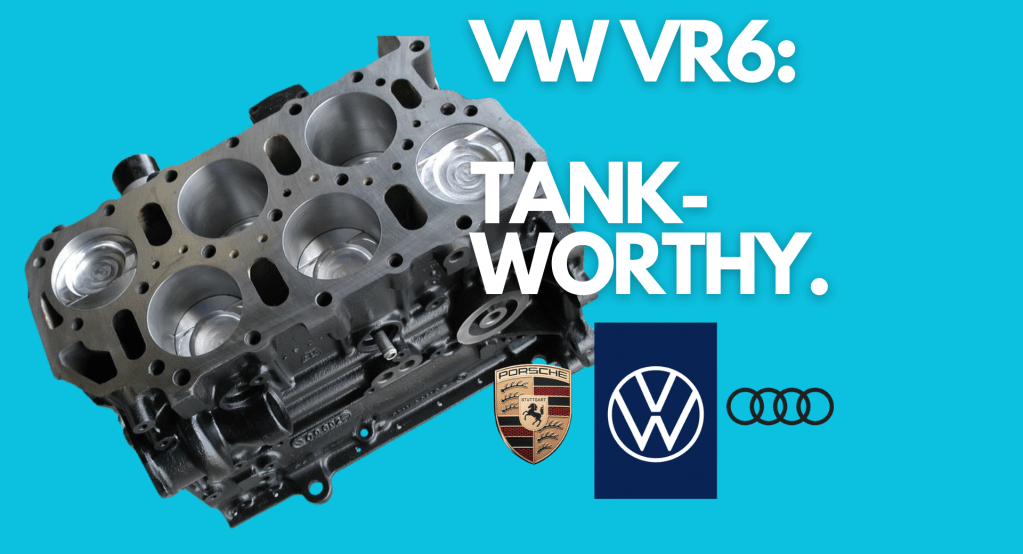
The “V6” often found in many Volkswagen Auto Group vehicles (Porsche/Audi/VW) is not an actaul V6. It is the legendary VR6. The VR6 is near bulletproof motor designed by VW in the 80s. The design dates back to the 20s. The block has even been used as a basis for some diesels.
In this article, we revisit this special motor from an engineering aspect. There are numerous traits which make it a very reliable and sound motor for anything from daily-driver city status to off-roading ability.
What makes is special?
- First, the principle design. It is actaully an staggered inline engine with all cylinders only sharing one head. Not two, like a traditional V-configuration. (This makes it roughly 1 – 1.3x more durable and balanced than a comparative V6/V8.)
This is an inherently stable design that all inline engines benefit from. Old school Ford Mustangs, Camry Corolla, Hondas, BMW, etc. for example all began their lives as inline-4 and inline-6 vehicles.
Yes, it has the same 15-degree bank as a V6. No, it’s not a V6. Yes, it has an inline / flat shared head design. No, it’s not an inline-6.
It is a Verkürzt Reihenmotor 6 (VR6). Translated to English, it is a “shortened inline engine”. Not one or the other… But simply both. - Second, it uses an iron block. All other V6 / V8 use aluminum blocks. Although iron blocks dissipate heat “worse”, they are more stable under austere environments and are more robust.
This is why Iron Blocks are often used for heavy equipment machines, Diesels, etc. This makes it very popular for turbocharging as it is basically a tank engine. - Third, the VR6 uses steel cylinder liners that do not wear down. They are physical steel liners. Other V6 and V8 configs (excluding turbo models) use chemically treated cylinder liners which have sometimes known to cause “Bore Score” in cold climates compounded by poor maintenance.
(Most of the time when traditional Porsche V6 and V8 die, it is due to bore score at very high mileage. The cylinder coating falls apart and the engine must be re-sleeved. This is still a rare chance and a well maintained car will still have it’s chemically treated cylinder walls perfectly fine. This was more common on early Boxsters, Cayman, 911 anyway. Almost unheard of on Cayenne / Panamera by comparison.) - This is NOT the same type of “V6” used in the Panamera. The Panamera 3.6 is a fully Porsche aluminum unit. Both built different worlds apart, although that is a good engine on its own.
- The VR6 is still in use today inside of the Atlas SUV. VAG still badges it as the “V6”.
- At this point, you may be wondering why VAG still labels the engine as a “V6”. The ansewer for this is relativley simple. In it’s early days, VAG could not trust western markets to be open minded to the introduction of a new engine type. Americans were already used to the concept of V6 & V8, so VAG worried that labeling the motor as “VR6” would scare Americans. Of course among car enthusiasts, this badge would be a badge of honor…
Common VR6 Issues:
- Issues with these motors are very few overall. Early 80/90/00’s VR6 engines had timing chain and headgasket issues. This is relativley rare, but luckily was ONLY an issue on pre-2004 VR6
engines. - Like anything else with an engine, accesories could always fail. IE; Water pumps, hoses, battery, pulley, belt, etc. Nothing major or outside the scope of the average gasoline engine with some age on it.
In summary, it is a good “long-term motor”. This is one of those engines which can easily reach 400,000 miles and has been known to do so. It will not be as fast as it’s turbocharged V6 or V8 counterparts, but has the edge of being a tank-powerplant. It will outlast those previously mentioned platforms. It is an incredibly excellent engine choice for spirited driving, daily usage, off-roading, etc.
The Cayenne / Toureg / Atlas are three popular SUVs with this engine, and alongside their usage of the Toyota Aisin 8-Speed Automatic Transmission, they are quite literally the German versions of the Toyota Land Cruiser.
Vehicles with the VR6 engine (optional or standard):
Audi
- Audi TT Mk1 and Mk2 (2003–2010)
- Audi A3 (8P) (2003–2013)
- Audi Q7 (4L) (2008–2015)
- Audi Q6 (2022–2024)
Porsche
- Porsche Cayenne E1 and E2 generations (2002–2018)
SEAT
- SEAT Alhambra (7M) (1996–2010)
- SEAT León (1M) (2000–2004)
Škoda
- Škoda Superb (3T) (2008–2014)
Volkswagen
- Volkswagen Corrado (1991–1995)
- Volkswagen Passat (B3, B4, B6, B7 generations) (1991–2015)
- Volkswagen Golf Mk3 (1992–1998)
- Volkswagen Vento / Volkswagen Jetta Mk3 (1992–1999)
- Volkswagen Sharan (1995–2000)
- Volkswagen Transporter (T4) (1996–2003)
- Volkswagen Golf Mk4 (1998–2003)
- Volkswagen Bora / Volkswagen Jetta Mk4 (1999–2005)
- Volkswagen New Beetle RSi (2001–2003)
- Volkswagen Phaeton (2002–2016)
- Volkswagen Touareg (2002–2018)
- Volkswagen Transporter (T5) (2003–2009)
- Volkswagen Golf Mk5 R32 (2005–2008)
- Volkswagen Eos (2006–2011)
- Volkswagen CC (2008–2017)
- Volkswagen Passat NMS (2011–2018)
- Volkswagen Atlas (2017–2024)
- Volkswagen Teramont (2017–2024)
- Volkswagen Talagon (2021–2024)

 Euro-Kar syndicate.
Leave a comment