
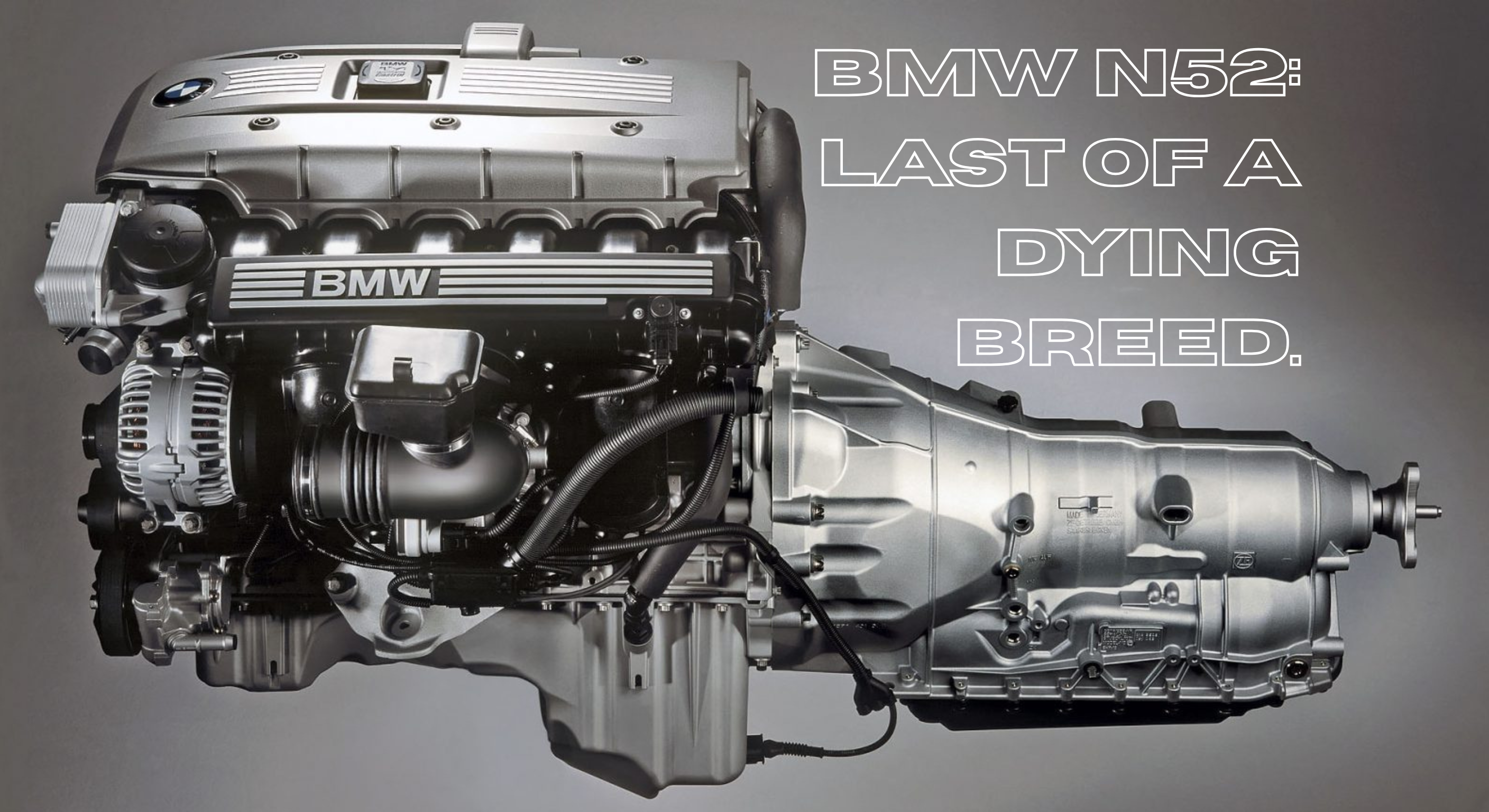
The BMW N52 Might Actually Be The Last “Real” BMW Engine
If you’ve spent any time in BMW circles — whether that’s forums, TikTok, or arguing in a parking lot at 1am — you’ve probably heard someone say:
“Yeah bro… the N52 is peak BMW.”
And honestly?
They might not be wrong.
Because the N52 wasn’t just another inline-six.
It was:
- The last naturally aspirated BMW I6
- The last “simple” modern BMW engine
- And possibly the last time BMW built something that wasn’t trying to out-smart you with boost pressure and software
In a weird way…
The N52 represents the exact moment BMW stopped being analog.
The Last Of The Naturally Aspirated Era
The N52 debuted in 2004 and ran all the way until 2015.
Which doesn’t sound crazy until you realize:
After the N52?
Everything started getting turbos.
BMW replaced it with engines like:
- N20
- N54
- N55
- B58
And while those engines made more power…
They also introduced:
- High pressure fuel pump failures
- Turbo issues
- Direct injection problems
- More heat
- More complexity
- More things to break
Meanwhile the N52 just sat there like:
“I make power with air and vibes.”
No turbo.
No direct injection.
Just 3.0L of naturally aspirated inline-six smoothness.
It even redlined at 7,000 RPM — something modern turbo engines don’t really care to do anymore.
Reliability? Actually… Yeah.
Now let’s get this out of the way:
It’s still a BMW.
Stuff breaks.
But compared to later turbocharged engines?
The N52 is considered above average in reliability and avoids many of the turbo-related issues seen in newer powertrains.
Owners regularly report:
- 180K miles
- 200K miles
- Sometimes even more
With minimal catastrophic issues when properly maintained.
Most of the common problems are honestly just:
- Valve cover gasket leaks
- Oil filter housing gasket leaks
- Oil pan gasket leaks
AKA:
Gaskets doing gasket things.
Nothing like the existential HPFP nightmares people experienced with early N54s.
The “Problematic Years” Aren’t Even That Bad
Jalopnik pointed out that technically the most problematic N52 years were:
2006–2011.
But here’s the funny part:
Even the “bad” N52s are still considered reliable for a BMW — and many issues have already been handled by previous owners by now.
There are also different variants like:
- N52
- N52K
- N52N
- N52T
Some introduced fixes…
Some introduced new quirks…
But none of them were deal-breakers.
As long as you replace aging plastic cooling components — like the infamous thermostat flange — the engine can easily keep going for years.
Why Enthusiasts Still Love It
Here’s where things get emotional.
Because the N52 wasn’t just reliable.
It was:
Lightweight — thanks to a magnesium-aluminum composite block
Smooth
Linear
Predictable
Naturally aspirated
Manual-friendly
It had:
- Valvetronic
- Double VANOS
- Electric water pump
- Variable intake
Which means BMW threw a ton of tech at it…
And somehow it still ended up durable.
That combo of:
High-revving NA sound + manual transmission
Is something you literally cannot get anymore in a modern four-door BMW.
Want a turbo B58 with seating for five?
Sure.
Want a naturally aspirated inline-six you can row your own gears in?
Welcome to Craigslist.
It’s Basically Becoming A Time Capsule
Modern BMW engines are objectively:
- Faster
- More efficient
- More powerful
- More emissions-friendly
But the N52 represents something else entirely:
A time when BMW built engines around feel.
Not boost targets.
Not emissions software.
Not hybrid integration.
Just:
Throttle response
Sound
And driver connection
It’s why some enthusiasts still hunt for:
- E90 328i
- E60 530i
- E85 Z4
- X3 28i
Instead of newer turbo models.
Because even if they’re slower…
They feel better.
The Takeaway
The N52 isn’t the fastest BMW engine ever made.
It’s not the most efficient.
And it definitely isn’t the most technologically advanced anymore.
But it might be:
The last BMW inline-six that feels like it was built for drivers instead of spreadsheets.
So while modern BMWs chase:
Boost
Hybrid torque
Software optimization
The N52 just keeps doing what it’s always done:
Revving to 7,000 RPM
Sounding amazing
And hitting 200K miles like it’s nothing
No turbo required.


Leave a Reply